
Organize Scarves in Small Closets: A Space-Saving Guide
Last Updated: November 20, 2026
Quick Summary
To organize scarves in small closets, start by decluttering into three piles (wear regularly, seasonal, rarely worn) and measuring your rail, shelf and drawer space before buying anything. Then match one hanging method, like a multi-slot hanger or over-door rack, with one folded method suited to each fabric.
- A multi-slot hanger holds 5 to 10 lightweight scarves in about the width of a jacket.
- Never hang silk or fine wool by a single point, as the weight pulls the weave out of shape.
- Roll silk and chiffon rather than folding flat, and store them in breathable bags away from light.
- Swap seasonal pieces twice a year, moving heavier wool up top in warm months.
- Renters should choose over-door storage and freestanding baskets to avoid drilling holes.
Table of Contents
- Start With a Declutter and Closet Audit
- Scarf Storage Ideas That Fit Tight Closet Space
- How to Hang Scarves in a Closet Without Stretching Them
- How to Fold Scarves for Storage by Fabric Type
- Choosing a Scarf Organiser for Closet Layouts
- Protecting Delicate Fabrics and Rotating Seasonal Scarves
- Build Your Scarf Storage Setup This Weekend
- Frequently Asked Questions
Start With a Declutter and Closet Audit
Learning how to organize scarves in small closets starts with one honest question: how many of these do you actually wear, and how will you organize scarves you keep? Most of us keep scarves we haven't touched in years. They take up rail space, tangle with everything else, and make the whole wardrobe feel crowded.
A pile of scarves, no system, and nothing getting worn is a familiar picture for many people.
So before you buy a single hanger, sort the collection into three piles:
- Wear regularly: these stay within easy reach
- Seasonal: these move to a box or bag up high
- Rarely worn: these get donated, gifted, or repurposed
Now measure your closet. Note the rail length, shelf height, drawer depth, and door clearance. That audit tells you which storage method will actually fit.
A common mistake is buying a rack before checking the space. It ends up on the floor, holding nothing.
Good Shepherd Australia's guide to donating unwanted clothing is a practical starting point for passing on good-quality items you no longer wear.
Scarf Storage Ideas That Fit Tight Closet Space
The best scarf storage idea for a small closet is the one that uses the space you already have, not the one that looks prettiest online. To choose properly, compare methods on three things: how many scarves each method holds, how much closet footprint it consumes, and how quickly you can get a scarf out on a rushed morning.
| Method | Approximate capacity | Closet footprint | Access speed | Best for |
|---|---|---|---|---|
| Multi-slot hanger | 5-10 lightweight scarves | One rail spot (about the width of a jacket) | Fast | Daily-wear cotton, linen, lightweight blends |
| Over-door hooks or rack | 6-12 scarves, depending on hook spacing | Zero rail or shelf space; uses door back | Fast | Renters, shared closets, no-drill setups |
| Folded in a drawer | 8-15 scarves in a standard 40-50 cm deep drawer | One drawer, roughly A4 footprint per stack | Medium | Silk, chiffon, fine wool |
| Clear bins on a high shelf | 10-20 scarves per 40-litre bin | Overhead shelf space only | Slow | Seasonal and bulky wool |
| Baskets or a breathable bag | 6-12 scarves | Shelf, floor corner, or under-bed | Medium | Pashmina, travel, overflow |
Measure your space before you buy, so the method you choose fits your closet.
Match the method to your actual constraint:
- Narrow rail, tall space: a multi-slot hanger for the daily rotation plus one high-shelf bin for the rest.
- No spare rail: over-door hooks or a rack. They cost nothing in rail space but add a few centimetres to the door's swing, which matters in tight bedrooms.
- Deep drawers: dividers or rolled storage. A single drawer can hold a full seasonal collection if you roll rather than fold flat.
- Shared wardrobe: one hanging organiser per person, labelled, so scarves don't migrate.
- Rental with no drilling: freestanding baskets and over-door options only.
Renters should lean toward over-door storage and freestanding baskets. No holes, no damage, no bond issues.
We stock a Cotton Linen Collection because lightweight cotton and linen scarves fold flat and stack neatly, which makes them ideal for tight drawer space. Bulky wool takes a different approach.
Buy to your actual count, not the maximum a rack claims to hold.
How to Hang Scarves in a Closet Without Stretching Them
Hanging is the fastest access method, but it ruins delicate fabrics if you get it wrong. The fix is simple: never hang a silk or fine wool scarf by a single point. The weight pulls the weave out of shape over time.
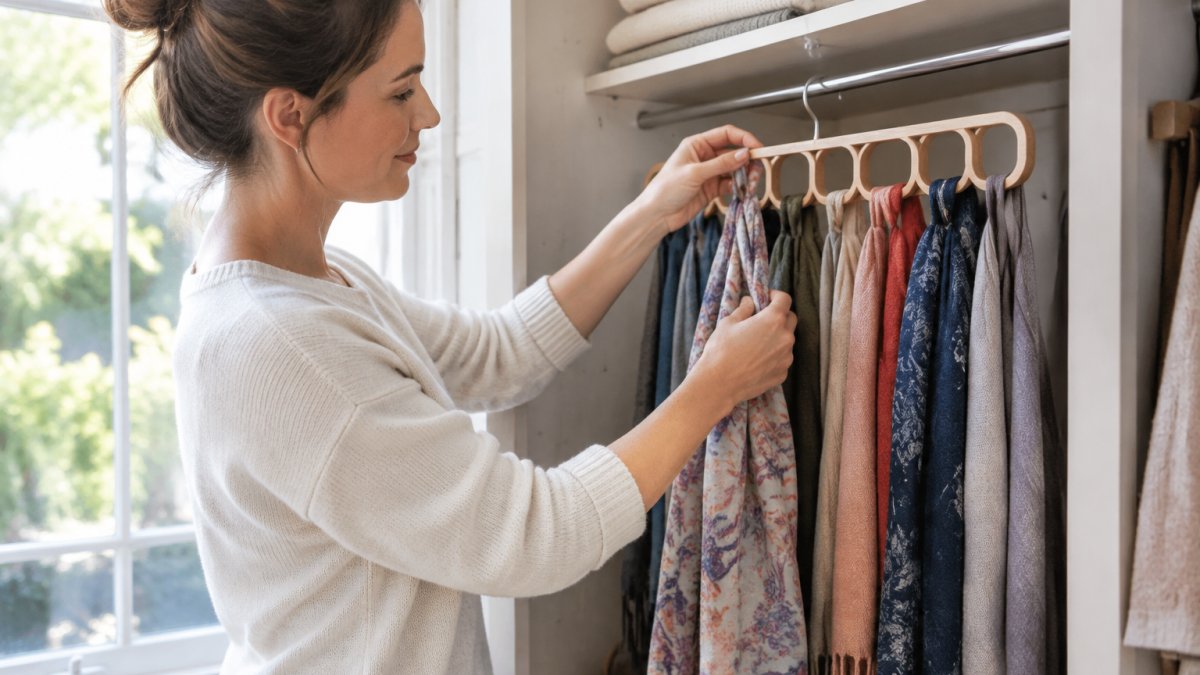
Here's the method we recommend:
- Fold the scarf in half, then in half again
- Loop it loosely over the hanger slot
- Let the ends hang free rather than knotting them
- Keep heavy wool off thin wire hangers entirely
A multi-slot hanger holds several scarves in the space of one garment. That's the single biggest win in a small closet.
Watch out: cramming too many scarves onto one hanger creates pressure marks along the fold. Leave a finger's width between each one.
How to Fold Scarves for Storage by Fabric Type
Folding is where most collections go wrong. Silk creases, wool holds shape, and chiffon snags, but the reason each fabric fails is different, and the fold plus the storage medium have to address that specific failure. Match both to the fabric.
How to fold scarves for storage, by type:
- Silk: fold loosely into thirds, then roll. Never press a hard crease, silk fibres break along a sharp fold line and the mark becomes permanent. Store rolled in a drawer or a breathable bag, away from direct light, which fades dyed silk over a season.
- Chiffon: roll rather than fold, and keep it separate. Chiffon snags on the raw edges of other fabrics and on plastic drawer dividers; a linen or cotton pouch prevents most of it.
- Cotton and linen: fold flat into a rectangle and stack. These fabrics crease predictably and relax again when hung, so a flat stack is fine and the most space-efficient option.
- Wool and pashmina: fold loosely and store with breathing room. Wool needs airflow; compressed in a sealed plastic box it can hold damp and develop mustiness. A breathable bag or a lidded basket with ventilation is better than vacuum sealing for anything you wear each season.
- Knitted scarves: roll to avoid stretching the knit. Hanging a knit by one end pulls it out of shape under its own weight; rolling keeps the loops relaxed.
If you're working through folding techniques, our guide on how to fold a shawl for elegance covers the dressier wraps in more detail.
Chiffon needs the gentlest handling of all. If you're browsing fabrics that demand careful storage, our Chiffon Scarf Collection is worth a look before you plan the drawer.
Storage medium matters as much as the fold. Plastic containers trap moisture and, over a humid summer, that moisture sits against the fabric. Linen and cotton bags let air move around stored scarves, which reduces dust and snagging without sealing in damp. For anything stored for months, check each season for moths.
Seasonal rotation is part of folding, not an afterthought. Twice a year, swap the collection: heavier wool and pashmina up top in the warm months, lightweight cotton and silk forward when the weather cools.
Make sure a scarf is completely dry before storing it, and air wool pieces before packing them away.
Choosing a Scarf Organiser for Closet Layouts
The right scarf organiser depends on your closet's shape, not its size. Use this decision guide:
- Narrow rail, tall space: multi-slot hanger plus a high shelf bin
- No rail space: over-door rack or hooks
- Deep drawers: dividers or rolled storage
- Shared wardrobe: one hanging organiser per person
- Rental with no drilling: freestanding baskets and over-door options
For drawer and travel storage, a breathable option beats plastic. Our Linen Scarf Storage Bag is made from natural linen, which allows airflow around stored fabrics and helps protect scarves from dust and snagging. It is suitable for scarves, shawls, pashminas and wraps.
Protecting Delicate Fabrics and Rotating Seasonal Scarves
Storage isn't the end of the job. Scarves need a rotation, or the ones at the back never see daylight. We suggest swapping your seasonal pieces twice a year: heavier wool and pashmina up top in the warm months, lightweight cotton and silk forward when the weather cools.
A few habits protect delicate fabrics:
- Store only clean, completely dry scarves
- Keep silk out of direct sunlight
- Avoid wire hangers for anything fine
- Air wool pieces before packing them away
- Check stored items for moths each season
For deeper care guidance, our article on how to keep scarves looking new walks through washing and fabric-specific handling.
Build Your Scarf Storage Setup This Weekend
You can set up a working system in an afternoon. Start with the audit, sort into three piles, then match your closet layout to one hanging method and one folded method. Add a breathable bag for the seasonal pieces and you're done.
The challenge most people face isn't space. It's having scarves worth displaying. A collection you love gets worn, and a collection you wear stays organized.
That's where we come in. Scarves Australia offers a boutique range of scarves, pashminas, shawls, and wraps for men and women, with a wide variety of fabrics and colours across all seasons. The range is built to help you change your look with a single accessory. Start with one piece you'll actually reach for, then build the storage around it.
Get started with Scarves Australia and find a scarf you'll want to keep within easy reach.
Frequently Asked Questions
How do you store scarves in a small closet?
Match the method to the space you have. If your closet has a spare rail, hang lightweight scarves on a multi-slot hanger so each one is visible. For shelves, roll knit and wool scarves into clear bins so you can see colours at a glance. For drawers, fold silk and fine fabrics flat with the fold facing up. Keeping one method per fabric type prevents tangles and stops scarves piling up on the floor.
Is it better to fold or hang scarves?
It depends on the fabric. Silk, satin and lightweight cotton do best folded flat or rolled, because hanging them by a single point can stretch the weave over time. Wool, cashmere and thick winter scarves hold their shape on a padded hanger or a wide-shouldered hanger. If you are short on rail space, folding into drawers or bins frees up the rail for coats and dresses.
How do you keep scarves from slipping off hangers?
Use hangers with slots, clips or a textured surface rather than smooth plastic. Loop each scarf through a slot and let the ends hang evenly so the weight is balanced. For silky fabrics, a hanger with a felt or velour coating grips better than bare plastic. Avoid hanging more than one or two scarves per slot, since overloading stretches the fabric and causes the hanger to sag.
How do you organise a large scarf collection?
Split the collection by season and fabric first, then store the out-of-season pieces in breathable bags on a high shelf or under the bed. A linen scarf storage bag keeps dust off and lets air circulate around the fabric. Keep the current season on the rail or in a drawer at eye level. Rotating twice a year keeps the closet from overflowing and makes choosing a scarf each morning much faster.