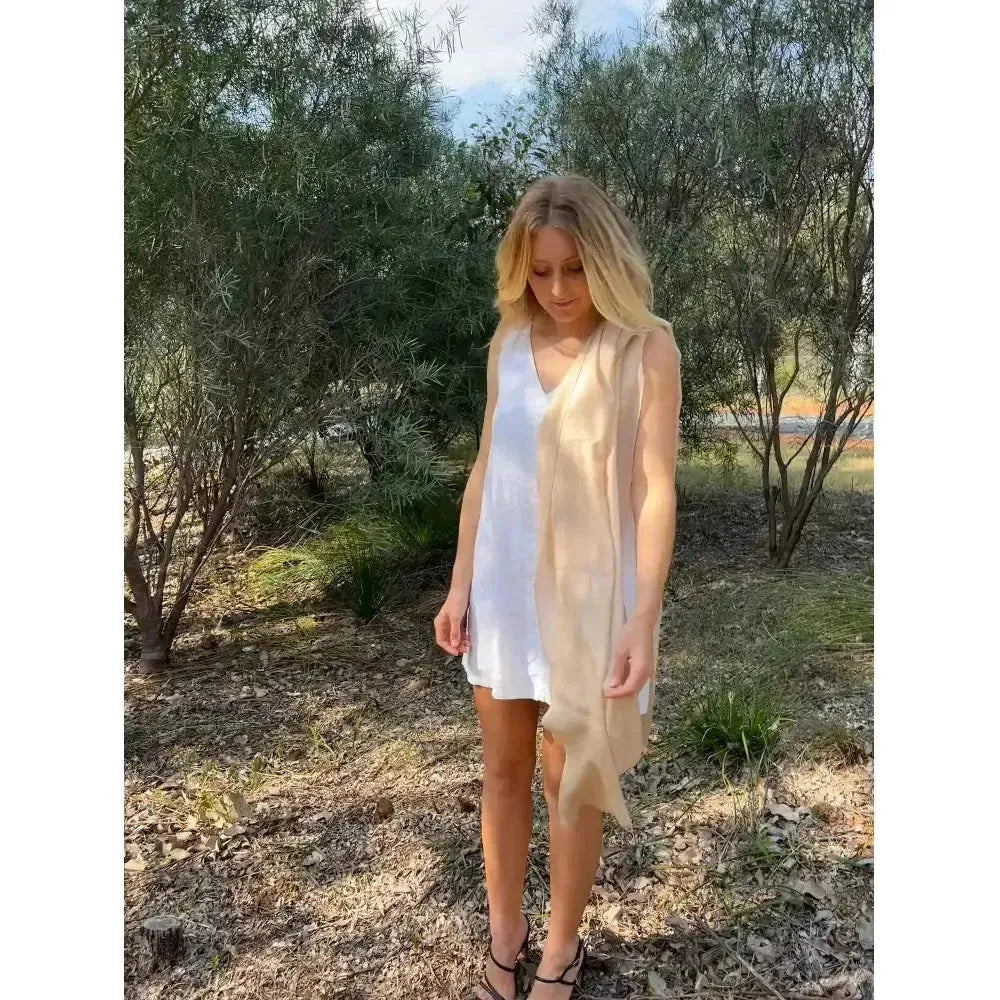

Silk Scarves Australia: 2026 Review & Styling Guide
Table of Contents
- What to Look For in a Silk Scarf
- Silk vs Synthetic: How to Tell Real Silk From Polyester
- How to Style a Silk Scarf: Four Ways That Work
- Pure Silk Scarf Price: What You Actually Pay
- Silk Scarf Care Instructions for Long-Lasting Colour
- Our Picks: Silk and Silk-Feel Scarves Worth Buying
- Occasion and Season: Matching the Scarf to the Moment
- Conclusion
- Frequently Asked Questions
Last Updated: September 14, 2026
What to Look For in a Silk Scarf
A silk scarf is a square or rectangular piece of silk fabric worn around the neck, hair, or shoulders. Choosing the right silk scarf comes down to fabric quality and size.
Fabric quality shows in how a scarf feels and catches light. Genuine mulberry silk has a natural sheen that shifts as you move; synthetic blends look flat. Run the fabric between your fingers: real silk warms quickly and feels smooth, never plastic.
Fabric, Finish and Feel
Weight matters more than most buyers expect. Lightweight silk drapes softly for spring and summer; heavier twill holds a knot firmly.
Check the edges first. Hand-rolled edges are stitched and turned by hand, giving a raised, rounded finish; machine-hemmed edges sit flat. The finish tells you more than any label claim.
Size, Shape and Drape
Square scarves in the 50-70cm range suit neck ties and hair styling. Larger 90cm squares open up more tying options and work as a light shoulder cover. Long rectangular styles suit a single loop or loose drape.
Too stiff and it won't hold a soft knot; too flimsy and it slides out within minutes. Look for fabric with enough body to hold a shape but enough fluidity to fall naturally.
Silk vs Synthetic: How to Tell Real Silk From Polyester
Real silk burns to ash and smells like burnt hair; polyester melts into a hard bead and smells like plastic. You won't run that test in a shop, so here are the checks that work in person.
- Sheen: Silk reflects light softly and unevenly. Polyester throws back a sharp, uniform shine.
- Warmth: Press the fabric to your cheek. Silk warms to skin temperature within seconds. Synthetics stay cool.
- Wrinkle test: Crush a corner in your fist, then release. Silk springs back with soft creases. Polyester holds hard, sharp folds.
- Weight in hand: Silk feels denser than its appearance suggests. Cheap satin feels weightless and slippery.
- Static: Rub the fabric briskly. Synthetics crackle and cling to your hand. Silk stays quiet.
Australian Competition and Consumer Commission guidance on country of origin and fibre labelling requires sellers to label textile fibre content accurately, so a genuine silk product must state its composition. If a listing avoids naming the fibre, treat that as a warning sign.
Synthetic blends aren't automatically bad. A cotton-modal blend gives a soft, breathable drape at a lower price and holds colour well. The problem is paying silk prices for polyester.
How to Style a Silk Scarf: Four Ways That Work
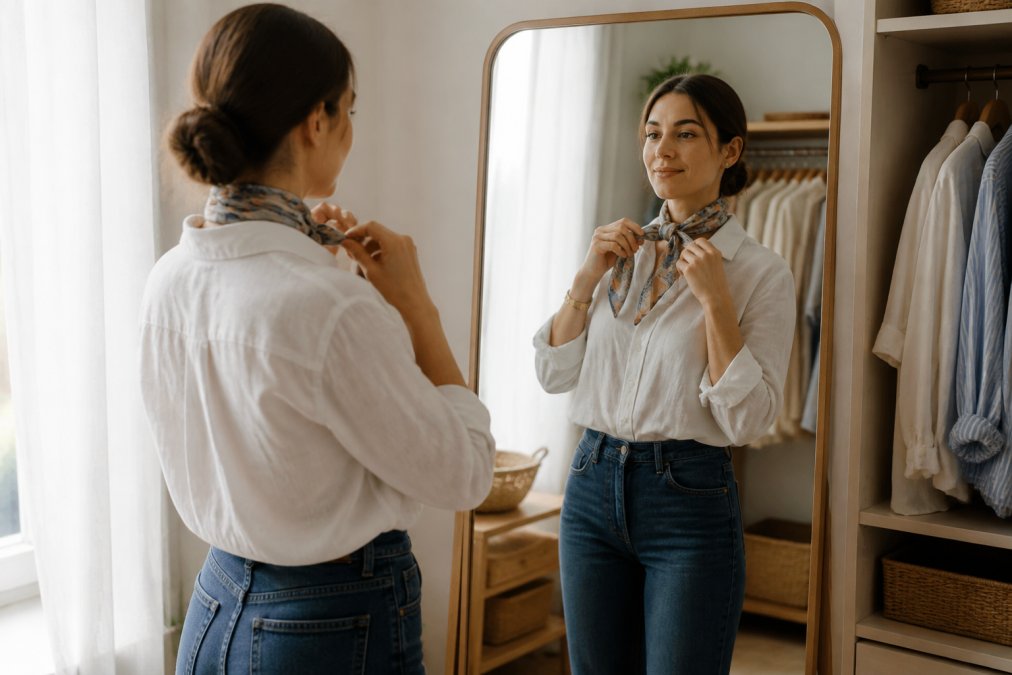
The fastest way to stop a scarf sitting in a drawer is to learn four ties and rotate them. Most people default to one knot, get bored, and abandon the accessory. Follow these once and you can repeat them without thinking.
Neck, Hair, Handbag or Shoulder
The neck knot. Fold a square scarf into a triangle, roll from the point toward the folded edge into a band about 8-10cm wide, wrap it around your neck with the ends meeting at the front, cross once, and tie a single knot slightly off-centre. Works over a shirt collar, knit, or plain tee, and is the default tie for a 50-70cm square.

The hair tie. Fold into a narrow band and tie around a ponytail, or fold into a triangle and knot at the nape as a headband. Keep the knot at the nape so it doesn't press against your head. A 50cm square is the sweet spot; anything larger adds bulk.
The handbag wrap. Fold a small square into a band, wrap twice around a tote handle, and tie a single knot with the tails hanging. This refreshes a plain bag in seconds.
The shoulder drape. Open a large square or shawl fully and drape it over both shoulders, pinning one side if you want it to stay put. A 90cm square or pashmina works best; smaller squares look like a bib.
A common mistake is matching the scarf exactly to the outfit. Contrast works better. A deep red wine pashmina over a black dress reads sharper than a black scarf over a black dress.
Matching the Tie to the Occasion
Occasion |
Best Tie |
Fabric Weight |
Size |
|---|---|---|---|
Corporate / office |
Neck knot, off-centre |
Lightweight twill |
50-70cm square |
Wedding or formal |
Shoulder drape, pinned |
Medium-weight woven or pashmina |
90cm square or shawl |
Casual weekend |
Hair tie or handbag wrap |
Lightweight silk or cotton modal |
50cm square |
Travel |
Shoulder drape, then neck knot |
Medium-weight crinkle |
90cm square |
For corporate settings, keep the print small and the knot tight. For weddings, a cream or off-white pashmina over one shoulder reads more formal than a printed square. For casual wear, the handbag wrap adds colour with the least effort.
Three Fixes for Common Styling Problems
The knot won't hold. Smooth silk slides against itself. Switch to a twill or jacquard, double the knot, or hide a small safety pin under the fold for a formal drape.
The scarf looks bulky at the neck. You're using too large a square. A 90cm square folded into a band is roughly twice the bulk of a 50cm square. Size down for neck knots and save large squares for shoulder drapes.
The colour clashes. Pull one colour from the scarf and match it to a solid in the outfit, rather than matching the scarf to the outfit. A scarf with three colours gives you three anchor options.
Pure Silk Scarf Price: What You Actually Pay
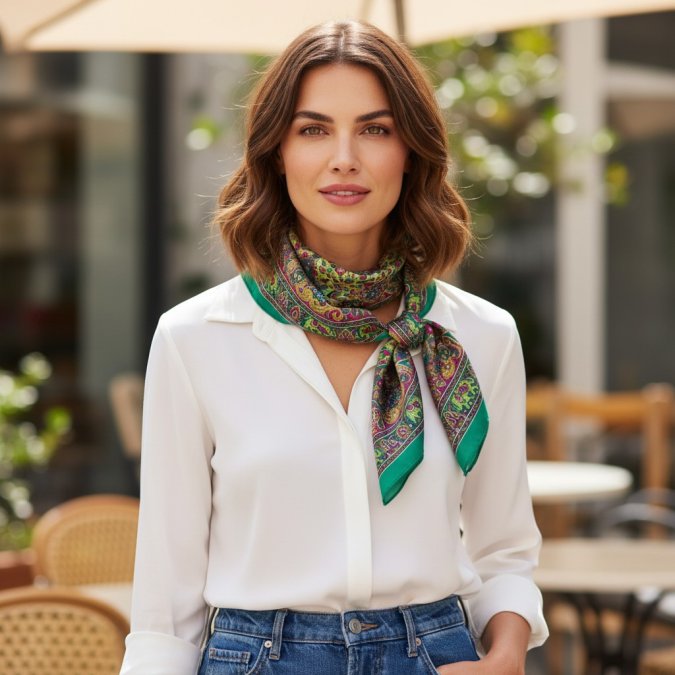
Scarf prices sit higher for natural fibres because raw materials cost more to produce and finish. The gap reflects fibre content, edge finishing, and print method, not just brand name.
Here's how the range breaks down at Scarves Australia:
Product |
Material |
Price |
Best For |
|---|---|---|---|
Poppy Scarf - Red on Black |
Cotton Modal |
$69.00 |
Everyday colour, Anzac Day |
Equestrian Horse Print Silky Square Scarf - Taupe |
Silky-look polyester |
$49.00 |
Neck, hair and handbag styling |
Evergreen Panelled Crinkle Scarf |
Lightweight crinkle |
$55.00 |
Travel, no-iron wear |
Watercolour Bloom Scarf |
Cotton modal |
$69.00 |
Spring and summer colour |
Luxury Bloom Red Poppy Scarf Silk Modal |
Silk modal blend |
$139.00 |
Bold print, year-round wear |
Pure Silk Square 90cm x 90cm |
100% Mulberry Silk |
$139.00 |
Multi purpose layering |
Pure Silk Scarf Leopard Print Olive |
100% Habituai Silk |
$199.00 |
Between-season coverage |
Australian Border Force information on importing textile goods confirms that imported textiles attract duty and GST, which is part of why genuine silk costs what it does.
Watch for the bundle maths. Bundle any three scarves and save 20% with code BUNDLE20, which is a real saving rather than a marketing trick.
Silk Scarf Care Instructions for Long-Lasting Colour
Hand wash in cool water with a mild detergent, then lay it flat to dry away from direct sunlight (How to wash silk). That routine prevents almost every problem people blame on poor quality, but the right approach depends on the fabric type and weight.
Silk Grade and Momme: What You're Actually Caring For
Momme |
Weight |
Typical Use |
Care Note |
|---|---|---|---|
6-8mm |
Very light |
Sheer squares, summer scarves |
Handle gently; creases easily |
12-16mm |
Light to medium |
Standard neck squares |
Holds a knot; hand wash only |
19-22mm |
Medium to heavy |
Twill, structured scarves |
More durable; still hand wash |
22mm+ |
Heavy |
Shawls, outerwear layers |
Tolerates gentle machine wash on wool cycle |
Washing by Fabric Type
- Heavier twill (19mm+): Same routine, but you can swirl for up to a minute. The denser weave tolerates slightly more agitation.
- Wool-blend pashmina: Use a wool-specific detergent, wash in cool water, and avoid wringing at all costs. Dry flat in shade. Dry cleaning is the safest option for heavily embellished or hand-painted pieces.
- Cotton modal and crinkle blends: These are the most forgiving. Hand wash or use a delicate machine cycle, then hang or lay flat. The crinkle finish is designed to look unironed, so skip the iron entirely.
Drying, Ironing and Storing
- Drying: Roll the scarf in a clean towel to remove excess water, then lay flat on a drying rack. Skip the dryer entirely. Hanging wet silk stretches the fibres.
- Ironing: Press on the lowest silk setting while slightly damp, working from the reverse side. Never iron directly over a print. For crinkle styles, don't iron at all.
- Storing: Fold loosely and store flat or rolled. Hanging stretches the fibres over time. Keep silk away from direct sunlight and from wooden drawers that may have been treated with oils.
When to Dry Clean Instead
Hand washing is safe for most plain and printed scarves. Dry clean instead when the scarf is hand-painted, beaded, embroidered, or has a contrast border that may bleed. If the care label says "dry clean only," follow it. If it says nothing, hand wash is the lower-risk default for a medium-weight scarf.
Our Picks: Silk and Silk-Feel Scarves Worth Buying
Our top pick for most wardrobes is the Cherry Blossom Pure Silk Scarf at $129.00. This pure silk oblong scarf has a soft luxurious drape, and is a popular traditional design. It has enough length to hang as a loose swathe or can be folded as an elegant neck scar, head scarf or handbag decoration adding colour wherever you go. Totally portable and very light. You really can’t go wrong!
For colour that lifts a neutral wardrobe, the Pure Silk Square Collection all priced between $109.00 and $139 delivers a rich colourful array of unique silk square scarves in divine Mulberry Silk - ideal fo Spring and Summer and all year round wear for those who just prefer the gentle natural feel of this gorgeous natural fibre. So versatile and a quality choice from Scarves Australia.
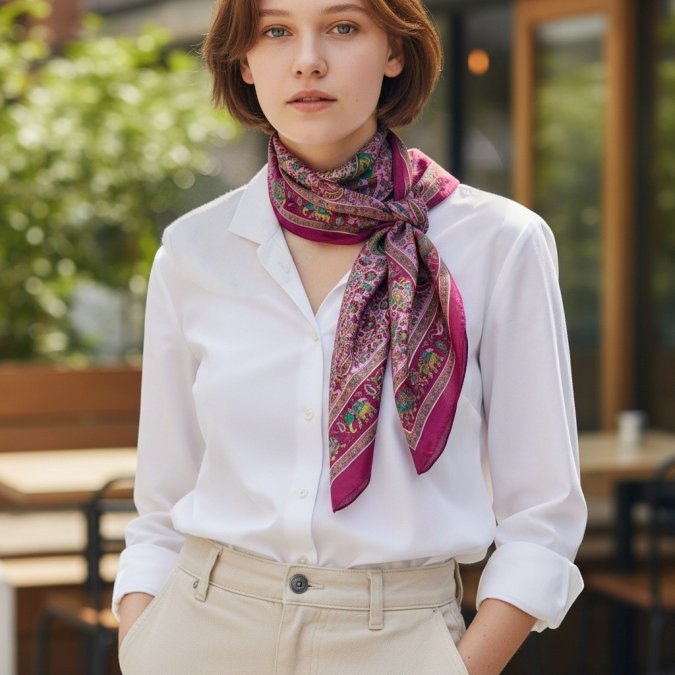
Rich Mulberry Pink Silk Scarf
For a gift under $50, the Equestrian Horse Print Silky Square Scarf - Taupe at $49.00 hits a specific niche. The horse motif suits anyone with an equestrian interest, and the neutral taupe palette keeps it wearable rather than novelty.
Two picks worth flagging for warmer months: the Watercolour Bloom Scarf at $69.00 and the Evergreen Panelled Crinkle Scarf at $55.00. Both are lightweight and breathable. The crinkle finish needs no ironing, which makes it the better travel choice.
The honest limitation across the range: the silky square styles are synthetic-feel rather than pure silk. What they offer instead is strong colour, easy care, and a price that makes a three-scarf rotation realistic.
Occasion and Season: Matching the Scarf to the Moment
Match fabric weight to the season and finish to the formality. That one rule covers almost every occasion.
Weddings and formal events. A cream or off-white pashmina drapes elegantly over a dress and doubles as a layer if the evening cools. The Off White Cream Pashmina Shawl at $125.00 is built for exactly this.
Autumn and winter. Deep, saturated tones work best. The Pashmina Shawl - Deep Red Wine at $125.00 pairs well with black, grey, camel, and chocolate.
Spring and summer. Go lightweight and bright. Cotton modal and crinkle styles breathe, pack flat, and add colour without weight.
Travel. One medium-weight shawl covers a plane, a cool evening, and a dinner outfit. Fold it into hand luggage and you've solved three packing problems with one item.
Gifting. A scarf is a safe gift when you know the recipient's colour preferences. Neutral tones suit almost anyone; bold prints need a confident wearer.
Conclusion
Choosing well comes down to knowing the fibre, finish, and size before you buy, then matching the weight to how you'll actually wear it. That's the difference between a scarf you reach for weekly and one that stays folded in a drawer.
Scarves Australia stocks a curated range across every price point, from a $45 poppy scarf to a $125 wool-blend pashmina, with same-day dispatch, free express post over $150, and a 30-day return policy if the colour isn't right in person. Bundle any three scarves and save 20% with code BUNDLE20.
Get started with Scarves Australia and build a scarf rotation you'll actually wear.
Frequently Asked Questions
How do I identify high-quality silk versus synthetic alternatives?
Look at the label first: natural fibres like wool or cotton modal are listed, while polyester and viscose are synthetic. Natural fibre blends feel warm to the touch, have a soft sheen rather than a plastic shine, and spring back when you crumple them. Synthetic blends tend to feel cool and slippery, crease sharply and hold static.
How much should a silk scarf cost?
Prices vary with fabric, size and finish. A lightweight square scarf in a silk-feel fabric can start around $45 to $55, while cotton modal and larger printed scarves sit closer to $69 to $75. Wool-blend pashmina shawls and wraps generally run from $109 to $125. Anything well below those figures is usually polyester or a thin blend, so check the fibre content before buying.
What are the best ways to care for a silk scarf to ensure longevity?
Hand wash in cool water with a mild detergent, then rinse without wringing. Press the water out gently in a towel and lay the scarf flat to dry away from direct sunlight, which fades colour. Iron on the lowest setting while slightly damp, on the reverse side. Store folded rather than hung so the fabric does not stretch, and keep it away from perfume sprayed directly onto the silk.
Where is the best place to buy silk scarves?
Buy from a seller who lists the fibre content, the size and the finish on the product page, and who offers clear returns. Scarves Australia stocks silk-feel squares, cotton modal scarves and wool-blend pashminas with same day dispatch, free express post over $150 and a 30-day return policy. That combination lets you check the drape and colour in person and send it back if it is not right.
Will a silk scarf actually get worn, or just sit in a drawer?
The scarves that get worn are the ones that match what you already own. Pick a colour that appears in at least three outfits you wear often, and choose a size you can tie in under a minute. A small square works as a neck scarf or bag accessory, while a large shawl doubles as a layer on cool evenings. Starting with one versatile piece beats buying five that clash.